
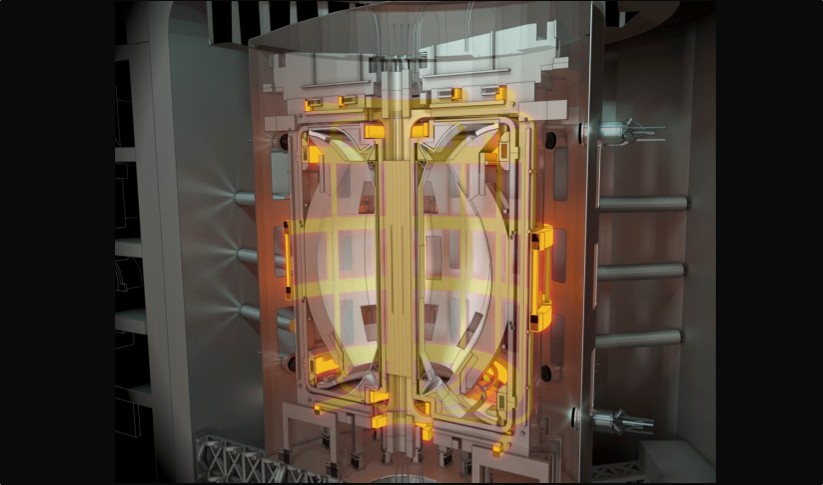
Oxford Sigma is pleased to announce the publication of a peer-reviewed paper, “STEP Limiter Architecture and Plasma-Facing Component Concept Design,” now available in IEEE Transactions on Plasma Science. The paper is the result of a close collaboration between Oxford Sigma, the UK Atomic Energy Authority (UKAEA), and UK Fusion Energy Ltd (UKFE).
The publication presents key developments in the conceptual design of plasma‑facing components (PFCs) for the Spherical Tokamak for Energy Production (STEP), the UK’s flagship programme to deliver a first‑of‑a‑kind fusion prototype power plant.
Oxford Sigma led key aspects of the materials selection strategy and plasma‑facing component design development, contributing its expertise in high heat‑flux materials, thermal management concepts, and engineering down‑selection. The company played a central role in assessing manufacturability, technology readiness level (TRL), and performance trade‑offs to support a credible and deployable limiter architecture for STEP.
Limiters are strategically placed PFCs installed on the first wall of a fusion device. Their primary role is to manage ultrahigh transient heat loads caused by plasma disruptions, such as vertical displacement events, effectively reducing damage to other critical in-vessel components.
The paper describes the current STEP Limiter architecture and documents the evolution of the limiter PFC design . The updated concept adopts a jet impingement gas-cooled, featuring tungsten armour paired with a CuCrZr alloy heat sink, representing a transition away from earlier tungsten heavy alloy concepts. The revised design covers a larger plasma-facing surface area and incorporates an internal manifold alongside pin fins to substantially improve cooling performance. The addition of pin fins enhances heat transfer to the coolant, enabling the use of higher technology readiness level (TRL) materials, such as copper alloys and establishing a more robust and dependable engineering pathway for the STEP program.
The full scientific paper, STEP Limiter Architecture and Plasma-Facing Component Concept Design, is available through the IEEE Xplore digital library:
Kaijanen et al., “STEP Limiter Architecture and Plasma-Facing Component Concept Design,” in IEEE Transactions on Plasma Science, doi: 10.1109/TPS.2026.3679931.
“Managing the extreme transient heat loads from plasma disruptions is one of the most demanding engineering challenges in fusion energy. By evolving the limiter architecture to incorporate pin fins and copper alloy heat sinks, we are leveraging higher TRL materials to deliver robust, realistic solutions for the STEP prototype power plant. This paper highlights the critical importance of practical engineering in accelerating fusion commercialisation.”
— Dr Leandro Tanure, Senior Materials Engineer, Oxford Sigma
About Oxford Sigma
Oxford Sigma is a Fusion Technology company with a vision to tackle energy security and climate change by accelerating the commercialisation of fusion energy. Our mission is to deliver materials technology, materials solutions, and fusion design services. Oxford Sigma aims to produce advanced materials technologies, agnostic to fusion approach, for the materials ecosystem. Our fusion core materials are engineered to enable longer term operations for fusion pilot plants, with the aim of roll out to the first-of-a-kind commercial power stations. Oxford Sigma is internationally recognised as a key fusion materials and technological leader.
Get in touch at [email protected]
About STEP / UKFE
STEP (Spherical Tokamak for Energy Production) is a major technology and infrastructure programme that will demonstrate net energy from fusion, fuel self-sufficiency and a route to plant maintenance. UKAEA is STEP’s fusion partner and will work alongside STEP’s industry partners. The STEP programme is being delivered by UK Fusion Energy Ltd (UKFE) a wholly owned subsidiary of UKAEA Group. UKFE will lead STEP’s integrated delivery team to design and build the prototype plant at West Burton site in Nottinghamshire, targeting first operations in 2040s.