
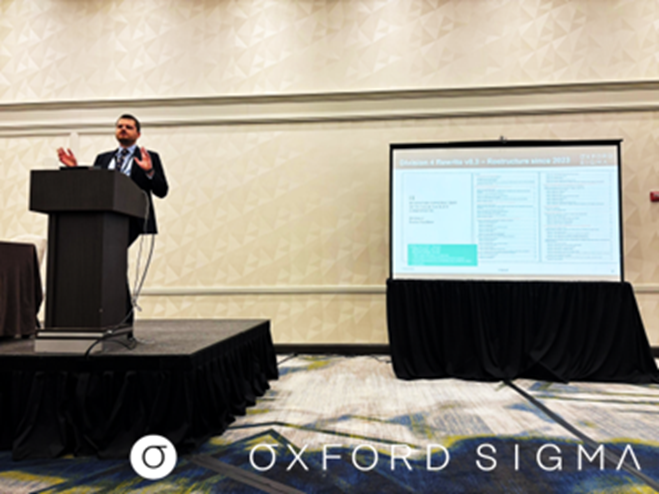
Oxford Sigma’s CEO, Dr Thomas Davis, led and delivered the Division 4 Workshop at the ASME Boiler and Pressure Vessel Code (BPVC) May 2026 Code Week in Denver on the Monday 11th 1 – 5pm May 2026. The session, led by Dr Thomas P Davis (also Chair, Subgroup Fusion Energy Devices), brought together an international group of engineers, regulators, and industry stakeholders to review and discuss the ongoing rewrite of Division 4. The workshop forms part of the continued development of fusion construction rules within ASME, supporting the transition from high-level framework to practical engineering application.
The five-hour workshop provided a detailed technical walkthrough of the Division 4 rewrite lead by Oxford Sigma, including structure, scope, and application to fusion systems. The rewrite is intended to establish a constructible, engineering-usable framework to support the design and delivery of fusion components, including:
- Materials, qualification, and certification
- Design and structural integrity
- Fabrication, examination, and testing
- Quality assurance requirements for nuclear service
The framework is:
- Technology-neutral, applicable across fusion approaches
- Environment-driven, based on service conditions and degradation mechanisms
- Component-focused, addressing structural integrity in nuclear environments
This work reflects an evolution from guidance to practical construction rules, informed by early use of the 2023 Code Edition and ongoing international input. The rewrite has now entered the ASME committee ballot process, where it is subject to formal review, comment, and technical scrutiny by the codes and standards community.
The ASME Boiler and Pressure Vessel Code (BPV Code) Section III, Division 4 establishes a technology‑neutral, fusion‑specific construction framework defining requirements for materials, design, fabrication, examination, testing, certification, and quality assurance for components operating under nuclear service conditions, with applicability determined by service environment, degradation mechanisms, and required structural integrity, rather than traditional fission-based assumptions.
Division 4 is developed through a formal, consensus‑based ASME process and is now in committee ballot, where it is subject to international review, comment, and technical scrutiny, with contributions—including those from Oxford Sigma—forming part of, but not representing, the collective standard.
“The Division 4 rewrite represents a transition toward a practical, engineering-usable construction framework for fusion systems. We have proposed and developed a structure that reflects how fusion components are designed, manufactured, and assured in practice. Critically, this work is being developed through a rigorous, consensus-based ASME process. The level of engagement, challenge, and technical scrutiny seen during the workshop and now through ballot review is essential to ensuring that Division 4 develops as a robust and internationally credible standard.”
Dr Thomas P Davis, Co-founder and CEO at Oxford Sigma
“The focus of the rewrite is ensuring that Division 4 can be applied in practice, aligning design, materials, and manufacturing into a coherent framework that reflects how fusion systems are actually engineered at the present. At its core, the ASME BPV Code represents established best practice, developed by engineers responsible for the design and construction of real nuclear systems. In areas where fusion technologies are still evolving, ASME provides the structured, mature engineering foundation against which these systems must be defined, validated, and ultimately delivered.”
Dr Emily Rose Lewis, Nuclear Materials Engineer at Oxford Sigma
About Oxford Sigma
Oxford Sigma is a Fusion Technology company with a vision to tackle energy security and climate change by accelerating the commercialisation of fusion energy. Our mission is to deliver materials technology, materials solutions, and fusion design services. Oxford Sigma aims to produce advanced materials technologies, agnostic to fusion approach, for the materials ecosystem. Our fusion core materials are engineered to enable longer term operations for fusion pilot plants, with the aim of roll out to the first-of-a-kind commercial power stations. Oxford Sigma is internationally recognised as a key fusion materials and technological leader.
Get in touch at [email protected]