
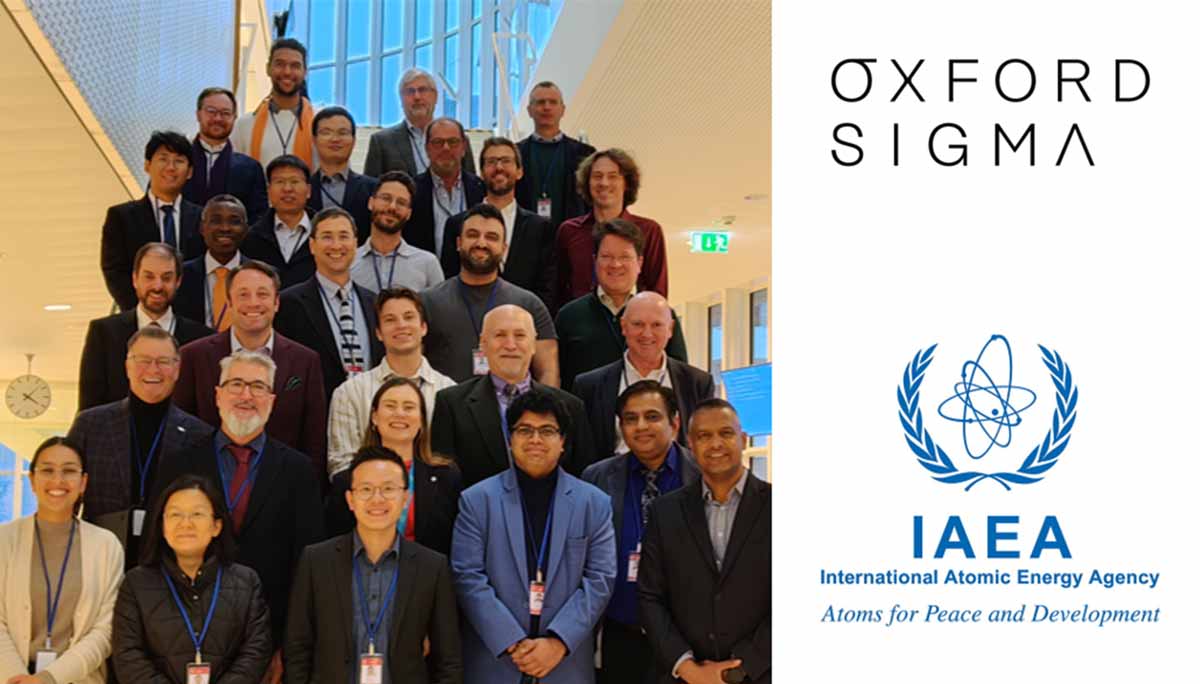
Oxford Sigma recently presented their work on the supply chain and materials perspectives in the first International Atomic Energy Agency (IAEA) Technical Meeting on Experience in Codes and Standards for Fusion Technology. Dr Alasdair Morrison, Chief Technology Officer at Oxford Sigma, presented an update on Oxford Sigma’s perspectives of how materials are currently applied, and how they may evolve, within voluntary consensus-based standards. This landmark meeting aimed to support and strengthen international collaboration on fusion research, and development with the goal of building scientific and technical knowledge in the field for the safe and efficient construction of future fusion power plants.
As a recognised leader in fusion materials technology and engineering, Oxford Sigma made a strong impact, and shaped discussions at this first anticipated biennial meeting. Our presence brought a supply chain perspective to the meeting of leading international experience from public and private fusion developers, research organisations, and academia. Participating in both presentations and panel discussions, major progress in developing a common knowledge base of what codes and standards (C&S) are being used, and developed, was achieved. These initiatives reflect Oxford Sigma’s mission to deliver the materials technology and engineering frameworks essential for safe, efficient, and scalable fusion power plants, shaping the future of fusion reactor design and deployment.
The IAEA organised the meeting following a series of consultancy meetings held by the IAEA in 2023 and 2024, and by the UK Atomic Energy Authority (UKAEA) in February 2025, this meeting focused on the development and identification of C&S for fusion. Inputs from the meeting are expected to contribute to an IAEA database on C&S which is being developed for the IAEA Fusion CONNECT (FUSE) platform which will help to identify common C&S which apply across fusion technologies.
Key themes from the meeting were:
- Clear advancement of fusion-specific C&S across major standards bodies such as ISO and ASME (American Society for Mechanical Engineers) – where Dr Thomas Davis, Oxford Sigma’s co-founder and CEO chairs the Boiler Pressure Vessel Code in Section III, Division 4, for Fusion Energy Devices.
- The need for clear plant definitions matter; demonstration plants and fusion power plants will have different C&S needs, and to promote discussion the industry needs to be clear on what development stage it is focusing on., which leads to:
- A need for common terminology to allow effective international collaboration and shared understanding across the fusion sector.
Dr Alasdair Morrison, CTO of Oxford Sigma said
“Voluntary consensus-based codes and standards underpin industry worldwide, this technical meeting brought together leading thinkers across the fusion sector internationally to share experiences. Presenting our perspectives on the use of materials across codes, standards and specifications continues our long-standing role in bringing the fusion sector to a common perspective on this critical topic. We support the efforts by the IAEA to commence this process now, whilst fusion progresses towards the demonstration phase to ensure safety is maintained in alignment with the hazards fusion power plant operation will bring, and that common knowledge and language is used.”
About Oxford Sigma
Oxford Sigma is a Fusion Technology company with a vision to tackle energy security and climate change by accelerating the commercialisation of fusion energy. Our mission is to deliver materials technology, materials solutions, and fusion design services. Oxford Sigma aims to produce advanced materials technologies, agnostic to fusion approach, for the materials ecosystem. Our fusion core materials are engineered to enable longer term operations for fusion pilot plants, with the aim of roll out to the first-of-a-kind commercial power stations. Oxford Sigma is internationally recognised as a key fusion materials and technological leader.
Get in touch at [email protected]
About IAEA
The IAEA fosters international collaboration and coordination to help close the existing gaps in physics, technology and regulation and move forward in developing the peaceful use of fusion energy. The IAEA is an autonomous international organization within the United Nations system. It partners with more than a dozen UN organizations, thereby helping extend the reach of its services.
International Atomic Energy Agency | Atoms for Peace and Development